Showing posts with label Young Israel. Show all posts

22 August 2008

Obama and Carter Party in Denver

Ok, I think I am beginning to understand democrat logic which actually scares me. No, I haven't bought in - Chas v'Shalom, but I am seeing a picture now which I will try to illustrate.

The modern liberal/democrat must be able to ignore truth for vision. Vision of course, without truth is fantasy. But that doesn't stop the left. When fantastical beliefs in new ideas emerge, ideas which are based upon fantasy more so than observation, on idealism more so than realism, on a slavish connection to a misnomer casting away thoughtful analysis, then you have liberal thought.

Basing policy on this reasoning is the core mandate of liberal democrats. Even when it is pitifully obvious that the results of this process is destructive, the process is held in such esteem that the results cannot be criticized. Jimmy Carter's priorities in foreign policy come from that system. It permits antiJewism so long as his far-fetched policy derived from the fantasy led process of analysis is intact.

Carter will be speaking at the Democrat National Convention next week in Denver. Even though there are still some level headed Democrats around who understand that the Carter chain around the neck of Obama is a poltergeist of Joseph Goebbels which Obama will have to wear through November, they are powerless to prevent a talk by the former President who is the standard setter for liberal thought today. The process must have its day after all.

What message is Obama trying to send? Clearly he or his team have approved or cancelled speakers at the convention. So Obama must approve of Carter the antiJew speaking at his convention. Democrats have a problem because they have fostered and accepted this sort of non-sense thought inside their tent. Obama is stuck with it whether he likes it or not. My guess is he does like it. It strengthens him and gives credence to his appeasement manner.

The dems are trying to stem the tide of the dissolving Jewish vote, putting "rabbis" on the agenda and continually trying to bolster Obama's Jewish credentials. But sending out Carter the fantastical antiJew to the podium will by necessity remind everyone of Carter's Jew baiting. This is not the best America can do.

Expect McCain to pick up additional Jewish support as a result of the dems convention and it's media coverage. The alternative media should have a field day with this one. Kudos to the Young Israel for their courage and leadership.


Young Israel Calls on Democrats to Cancel Carter Speech - INN


(IsraelNN.com) The National Council of Young Israel has called on Democratic presidential candidate Senator Barack Obama and party leaders to cancel next week's scheduled address by former American President Jimmy Carter at the party convention in Denver, Colorado. Carter's public statements and his recent visit to Syria have attracted widespread criticism among pro-Israel supporters.

Young Israel president Shlomo Z. Mostofsky and executive vice president Rabbi Pesach Lerner stated, "Affording Mr. Carter a prime speaking engagement on the Democrats' brightest stage is an affront to the State of Israel, and to all American Zionists, whether they are Christians or Jews.

"In April, 2008 he deliberately and wantonly ignored the wishes of the United States government when he traveled to Syria to meet with Khaled Mashaal, the head of Hamas' terrorist organization. The fact that he embraced Hamas, a terrorist group that has repeatedly called for the destruction of the State of Israel, the obliteration of the United States, and the annihilation of the Jewish people, was a slap in the face to Israel, the U.S., and Jews everywhere."


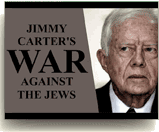
A Handy List of Carter is an AntiJew Articles
ZOA presser on Carter - poll manipulation

ZOA presser 2 on Carter - visits to Syria, recognition of Hamas


Condemnation of Carter book Palestine: Peace Not Apartheid as untruthful on Standwithus/ZOA flyerr


Zionist Leftie Criticism of Carter


Rawstory.com: Includes Carters NY Times OP/Ed which tries to explain why Jews should trust Hamas and how they convince other Americans that Hamas is really bad even though they are not (barf)


(Rosner article from Haaretz on trying to figure out how to sort antiJew Carter from a antiJew Mersheimer.

Deborah Lipstadt on antiJew Carter published by AISH


Levi Brackman, YNET calling Carter out


Foxman/ADLHe unjustly encourages Israel-bashers around the world.

Stumble Upon Toolbar

05 August 2008

The Rabbis Visit Postville: Evidence vs. Innuendo

Agriprocessors cannot stay out of the news. The latest report is of the
State of Iowa investigating under age employees, 57 minors to be exact
in violation of state employment laws. Iowa law has some provision
calling on employers to take special measures to be certain that all
employees are of legal age. What? No special measures to make certain
the employee is legally in the US?

I don't know what Iowa had in mind with this provision. But the basic
issue remains, these were workers who illegally entered the US and
were either provided by the company or someone else the Name, DOB, and
SSN of an American citizen in order to work. Agriprocessors
should launch a constitutional fight over the law protecting any
illegal workers, minor or otherwise. The unions want them protected
with same rights as US citizens and legal residents. I for one, do
not. These people were working here as identity thieves and resided illegally in the
US. They should just be sent home to wherever they came from. I have
little sympathy for people knowingly working illegally getting caught
and then crying foul about conditions and lack of rights. Go work in
Canada or Brazil.

If on the other hand, US citizens or legal residents under the age of
18 were employed in ways they should not have been or under conditions
inappropriate for workers then you have a different set of
circumstances.

As to the articles below, I am further of the opinion that Rabbis
should do Kashrus work and government employees should enforce the
laws of the land, be they state or federal. Rabbi Lerner led a team
of 25 Rabbis to Postville to tour the plant subject of the May ICE
bust. The report of his tour group can be read below. Overall, it
paints a very different picture than the media is portraying. Nevertheless, and meaning no disrespect to Rabbi Lerner and the Rabbonim he took to Iowa, their primary focus should be kashrus. Whether employees like their job or are being paid on time is not their business unless those same employees bring their claims to a beis din. Then it becomes a Rabbi matter. Otherwise, not.

To presume for a moment the thoughts of Agriprocessor's critics, it is
inconceivable except to the most perverted mind that this entire tour
group is bought and paid for, subject to bribery and arm twisting and
generally seeking the exact same outcome. To believe in such madness requires
one to be vulnerable to the most ridiculous conspiracies.

Speaking further to the idea of credibility is that unlike the
previous Heksher Tzedek tour, or the attacks by organized labor or
PETA, Rabbi Lerner's group cannot be said to enter this issue with a
preconceived conclusion or agenda. Think of the consequences if such a
conspiracy were true and revealed to the public? Think of the shanda
this would be and the chilul HaShem which would result? The careers
and lives ruined for a single cause? Its just not credible to believe
such fantasies. One does not have to look very far to see the
difference in the integrity category. Evidence is drawn from
experience and first hand observation. All else is hearsay, wishful
thinking and agenda driven propaganda. Is that correct Ari Hart? When will we hear from these same critics that the refuse to buy shoes, clothes, appliances and other goods from overseas producers where working conditions, payment and labor rights are appalling by every one's standards? Why single out Kashrus?

Finally, the last article heralds the long awaited meaningless guidelines for so-called ethical kashrus published by Morris Allen and Hechsher Tzdek. This doesn't warrant further discussion as the irrelevance is obvious. The Conservativists are merely seeking union membership. Nothing more will come of this effort which is destined to slip back into the anonymity from which it sprung forth.


FIRST FULL REPORT: National Rabbinic Mission Visits Postville Meat Plant - YWN
August 4, 2008
As was first reported HERE by YWN, a group of more than twenty
Orthodox Rabbinical leaders were scheduled to visit the Agriprocessors
plant in Postville, Iowa. Below is a report of that visit as written
by Aaron Troodler (one of the participants in the mission representing
the National Council of Young Israel):

A group of more than twenty Orthodox Jewish rabbinical leaders
representing several major Jewish organizations and large Jewish
communities visited the Agriprocessors plant in Postville, Iowa on
July 31st. Agriprocessors is the largest kosher meat and poultry
plant in the United States. The mission, which was spearheaded by
Rabbi Pesach Lerner, the Executive Vice President of the National
Council of Young Israel, was meant to provide the Jewish leaders with
a first-hand account of the state of the Agriprocessors plant and the
impact that recent developments have had on the Postville community.
It is believed that the delegation of Rabbis that visited the plant
last week was the first delegation to be inside the plant since the
May 2008 raid that was carried out by federal immigration agents.

"We have all heard many media reports coming out of Postville which
relate to the Agriprocessors plant," said Rabbi Lerner, "We wanted to
see first-hand the status of the facility's equipment and machinery,
examine the working conditions at the plant, and observe how the
employees are being treated."

The Rabbis flew into airports in a number of cities throughout the
Midwest, including Madison, Wisconsin, Cedar Rapids, Iowa, and
Dubuque, Iowa. As there is no airport near Postville, the Rabbis
traveled anywhere between two and five hours in cars and busses from
their respective airports to reach Postville. Following the mission,
the Rabbis' journey was no less tiring with several more hours spent
in cars and busses, and numerous flight delays which delayed their
return, with most of the Rabbis arriving home after midnight on
Thursday night.

The Rabbis began the day by touring the plant. Before embarking on
the tour, everyone was required to don a hard hat, hair and beard
nets, and a white coat to wear over their clothing, all of which was
intended to provide the visitors with a level of safety and to
maintain a high level of cleanliness at the plant. The visitors were
required to adhere to the same safety and hygienic standards that are
required of all workers at the facility.

Shortly after beginning the tour, which was led by managers at the
plant, word came of a tornado sighting in the area, which briefly put
the tour on hold. Soon thereafter, there was a weather-related power
outage at the plant. During that time, the Rabbis waited in the
plant's lunchroom, where many of the workers at the plant were there
on break. The participants conversed with the workers, both in
English and Spanish, and inquired about the working conditions at the
plant, including salaries, working hours, and benefits.

Every worker who spoke with the Rabbis expressed a degree of
satisfaction with how much they were being paid and the hours which
they worked. Some of the workers noted that the working conditions
and the hourly wages that they were being paid at the Agriprocessors
plant were a stark improvement over conditions they faced in other
meat and poultry plants that they had worked at in the past. Others
spoke about the opportunity for advancement that they had at
Agriprocessors, which were not available in other meat plants. A
reporter for the Five Towns Jewish Times filmed dozens of interviews
with randomly selected employees in English and Spanish. Those
interviews will be made available shortly on the Internet via You
Tube.

After the power was restored, the Rabbis spent time touring the plant,
during which time they observed the working conditions in various
parts of the facility and spoke with employees to get their
perspective about working conditions at the plant. Although several
of the plant's managers were leading the tour, the participants were
free to separate from the group and to walk around unimpeded if they
so desired. Many of the visitors did break away from the tour and
spent a great deal of time speaking to the workers and visiting
different areas of the plant unannounced.

The Rabbis also spent time examining the Kashruth standards (adherence
to Jewish dietary laws) at the Agriprocessors plant. The rabbinic
delegation walked through the slaughtering sections for both poultry
and beef, and observed all aspects of the processing of the foods
including the cooking and preparation of smoked meat.

Some of the Rabbis who are involved in Kashruth certification noted
several unusual innovations in kosher observance that are
unprecedented in the kosher food industry. Rabbi Zvi Zuravin of the
St. Louis Vaad Hair, one the oldest kosher certification agencies in
the United States, said "What impressed me the most was the
innovations in kosher slaughter, salting and the freedom of the kosher
supervisory agencies to operate without management's intrusion."

During the course of their tour, the Rabbis noticed a number of
inspectors from the United States Department of Agriculture (USDA),
which is the government agency responsible for overseeing the meat and
poultry production at the Agriprocessors plant. While speaking with
the Rabbis, the USDA inspectors said that the conditions at the plant,
and the plant's equipment and facilities were equal or better than
other facilities that they have observed.

Following the tour of the plant, the Rabbis took a tour of the city of
Postville. They saw the modern affordable housing complexes that the
Rubashkin family, the owners of Agriprocessors, had built for its
workers and for members of the Postville community. In fact, the
mission participants discovered that a number of the families of the
workers who were arrested during the May 12th raid are in fact still
living in housing provided by the Rubashkins and paying limited, if
any, rent. The Rabbis also saw several dilapidated trailers, which
are in visible need of repair, that were rented to workers by a
Postville City Councilman, and which were mistakenly portrayed in the
media as being owned and operated by Agriprocessors. The Rabbis also
saw Postville's day care center, which was built by a number of
individual and community groups, including the Rubashkins and
Agriprocessors.

The Rabbis also visited the $12 million environmentally-friendly water
treatment plant that Agriprocessors constructed. The director of the
facility, a professional with twenty-five years of experience in the
field, demonstrated to the visitors how the state-of-the-art plant
transforms unusable water to clean, healthy water for the city's
residents above the federally mandated requirements.

Postville Mayor Bob Penrod, whose family has been in Postville since
the 1950's, spoke to the rabbinic delegation about the central role
that Agriprocessors plays in the city. Mayor Penrod praised the
Rubashkin family's contribution to the economic and social well-being
of the town of 2,500, and explained that the plant was responsible for
employing more than one-third of the labor force in the ethnically
diverse city. The Mayor also spoke about how the May 12th raid at
Agriprocessors had negatively impacted the financial well-being of
Postville, and expressed hope that many Latino families would continue
to consider making Postville their home.

When asked by the Rabbis about some of the Postville residents who
have been vocal critics of the Agriprocessors plant, Mayor Penrod
explained that for some people, change is daunting, and there is a
desire among some to have the town revert back to the way it was in
the 1950's, before Postville became an ethnically diverse city.

"The Jewish community is extremely important to this town and we don't
want to see them leave," said Mayor Penrod.

Pastor Gary Catterson of the Presbyterian Church of Postville and
President of the city's Food Bank told the Rabbis that although he
heard the rumors in town about some of the reported abuses of workers,
"he had never seen a shred of evidence of any such abuses." Pastor
Catterson told stories of how the Rubashkins regularly contribute to
the Food Bank.

"We have had nothing but the best experience with the Rubashkin
family," said Pastor Catterson.

Ryan Regenold, a representative of Jacobson Staffing, the national
firm which presently oversees and works with the plant's human
resources operation, explained to the Rabbis that his firm is using
the federal government's E-Verification system in order to make
certain that illegal workers are not hired by Agriprocessors to work
at the plant. Although using the E-Verification system is not
mandatory, Regenold noted that it was being used at Agriprocessors to
ensure that all immigration-related policies and procedures mandated
by the federal government are strictly adhered to.

In addition, Regenold noted that Jacobson Staffing is utilizing
recruiting managers who are bilingual in an attempt to preclude any
possible miscommunication when dealing with potential workers during
the hiring process.

The Rabbis inquired about media reports which centered on workers who
were promised jobs and not hired, and others who were being underpaid.
In response to these questions, Regenold explained that Jacobson
Staffing advertises for workers all over the country, which is how the
group of Somali workers discussed in these news stories found their
way to Postville. Regenold said that the group merely answered a
nationwide ad. "We never promised anyone a job," said Regenold.
"Some workers we hired, while others either had issues with
immigration or were inappropriate for the jobs being advertised."
Those individuals who were not hired were given bus fare back to their
city of origin.

Regenold also told the Rabbis that Agriprocessors is paying its new
workers $10 an hour, which is well above Iowa's minimum wage, which is
currently $7.25 an hour. "The pay scale is the same for everyone," he
said. Regenold also said that as workers develop seniority, their pay
scale increases considerably, and that many workers voluntarily work
overtime, which pays 1 1/2 times the normal hourly rate.

Trent Gorton, a Postville resident who serves as the Safety Director
at the Agriprocessors plant, told the Rabbis that Agriprocessors is
nearly 100% compliant with all of the requirements set forth by the
United States Occupational Safety and Health Administration (OSHA).
Any outstanding items are being addressed and will be resolved
shortly. Generally, employers tend to fall short of complete
compliance with OSHA requirements, and a compliance rate of almost
100% is extraordinary. Gorton said that "working for the Rubashkin
family has been a treat," and that he is "encouraged and inspired by
what we are doing here."

James Martin, a former United States Attorney for the Eastern District
of Missouri who became Agriprocessors' compliance officer, reported on
some of the steps that have been taken at the plant in the area of
worker relations. Martin told the Rabbis that a toll-free hotline had
been put in place so that workers can confidentially report any
problems or concerns that they may have. Information about the
hotline is available for the workers throughout the plant in multiple
languages. In addition, Martin said that Agriprocessors has hired
former agents from OSHA, the Internal Revenue Service, and the United
States Immigration and Customs Enforcement, in order to maintain a
level of excellence at the plant when it comes to government
compliance.

"Safety is our number one priority, even ahead of production," Martin said.

Several of the Rabbis also met with worker advocates affiliated with
St. Bridget's Church, which historically has been critical of the
plant and its management. Although the entire group of Rabbis was
initially scheduled to meet with the church representatives, many of
the mission participants had to depart Postville in order to get to
the airports and catch their flights home. Due to the importance of
this meeting, four of the Rabbis did rearrange their travel plans and
remained behind in Postville in order to attend the meeting.

Rabbi Lerner of the National Council of Young Israel, Rabbi David
Eliezrie of the Rabbinical Council of Orange County, California, and
two other Rabbis from the group met with Paul Rael, the church's
Director of Lay Ministry, and Esther Lopez, a social worker associated
with the church, for more than an hour.

The church representatives cited specific cases of alleged worker
mistreatment at Agriprocessors and spoke about their desire to
investigate those claims. The Rabbis pledged to work with the
representatives of the workers and the management at Agriprocessors to
help facilitate their investigation and address the allegations. As
of this moment, the Rabbis are awaiting documentation of the alleged
abuses to workers of the Agriprocessors plant.

Rabbi Lerner noted that a great deal of the problems between the St.
Bridget's community and Agriprocessors was due to a lack of
communication. Although the church representatives acknowledged that
the Rubashkin family had made an overture to the church, to date no
meetings have taken place and there has been no direct communication
between the parties.

"Part of the problem here appears to be a lack of communication," said
Rabbi Lerner, "It became very evident that there needs to be a
dialogue between the church and Agriprocessors so that the two sides
can have an open and honest conversation about the issues at hand."

The Rabbis suggested that St. Bridget's Church and Agriprocessors
create a system where representatives from each entity meet with one
another once a week so that the two sides can establish a relationship
and a means by which issues and concerns can be addressed in person,
rather than through the media. The Rabbis discussed the proposal with
the church representatives and the management at Agriprocessors, both
of whom pledged to consider the proposal and get back to the Rabbis in
short order.

"We are hoping that we can create a bridge of understanding between
the Church representatives and the plant's management," said Rabbi
Lerner, who noted that this is the first time that there has been a
real effort to put the two groups together for the betterment of the
community, "Together they can address the issues affecting the workers
and actively seek solutions."

After visiting the Agriprocessors plant first-hand, personally
observing the operation, and speaking with the workers, the Rabbis
marveled at how the media reports, which have traditionally placed a
strong emphasis on statements from union officials and others who do
not necessarily have personal knowledge of the situation, actually
differ from the situation that they observed during their mission.

"The current situation at the Agriprocessors plant is diametrically
opposed to the rumors and innuendos that we had heard before we got
here," said Rabbi Lerner, the Executive Vice President of the National
Council of Young Israel, who organized the mission and led the group
that came from fifteen cities in the United states and Canada. Rabbi
Lerner's sentiments were shared by the other members of the mission.

"We saw the reality, not stories told over from others," explained one
member of the delegation, "That reality was far different than the one
that has portrayed in the press."

"There were no limitations placed on us as we inspected the facility
and no boundaries imposed during our visit - everything and everyone
was fair game," said Rabbi Lerner. "We discovered workers being
treated equitably and receiving fair wages and benefits. We saw a
state-of-the-art plant, a tremendous emphasis on safety, and excellent
standards of Kashruth. While we have no personal knowledge of what
may or may not have happened in the past, the Agriprocessors plant
that we saw today is far different than what has been reported."

Rabbi Lerner promised to continue to work hard "to set the record
straight with the help of the two-dozen witnesses who joined him on
the July 31st trip to Postville, Iowa. He explained that
Agriprocessors was an important part of Jewish life in America, and
noted that they are responsible for supplying 60% of glatt kosher beef
and 40% of kosher poultry in the United States. In addition, Rabbi
Lerner pointed out that Agriprocessors also supplies kosher meat and
chicken to some of the more remote communities in the United States,
which would have no access to kosher food but for the products they
receive from the Agriprocessors plant.

"What we observed in Postville was a 'Cadillac' with top of the line
machinery and a heavy emphasis on safety, security, and health," said
Rabbi Lerner. "Based on what we saw, this is a modern plant that is
servicing an important need and working diligently to adhere to the
highest workplace standards possible. What we saw and heard is how
the Rubashkins and Agriprocessors are going well above and beyond the
call of duty and the requirements of the law."

The following is a list of the individuals who traveled to Postville,
Iowa for last week's mission:

Rabbi Shmuel Bloom, Agudath Israel of America, New York Rabbi Naftali
Burnstein, Young Israel of Greater Cleveland, Ohio Mr. Yehuda Ceitlin,
COL, Radio 10 (Flatbush), Bakehila (Israel) Rabbi Edward Davis, Young
Israel of Hollywood-Ft. Lauderdale, Florida and ORB Kashrut Commission
Rabbi Yochonon Donn, Hamodia Newspaper, Brooklyn, New York Rabbi Moshe
Elefant, Orthodox Union, New York Rabbi David Eliezrie, Rabbinical
Council of Orange County, California Rabbi Chaim Goldberger,
Congregation Knesseth Israel of Minneapolis, Minnesota Rabbi Yair
Hoffman, Five Towns Jewish Times, Lawrence, New York Rabbi Yechiel
Kalish, Agudath Israel of America, Chicago, Illinois Rabbi Shauli
Klein, Vaad Hakashrus of Dallas, Texas Rabbi Pesach Lerner, National
Council of Young Israel, New York Rabbi Pinchos Lipschitz, Yated
Ne'eman Newspaper, Monsey, New York Mr. Menachem Lubinsky, Lubicom
Marketing Consulting, New York Rabbi Seth Mandel, Orthodox Union, New
York Rabbi Daniel Moscowitz, Chicago Rabbinical Council, Chicago,
Illinois Rabbi Chanoch Nelkin, Vaad Hatzdakus - Jewish Charity
Commission - Toronto, Canada Rabbi Shlomo Rybak, Congregation Adas
Israel in Passaic New Jersey, Rabbinical Council of America Rabbi
Dovid Schochet, Rabbinical Council of Ontario/Vaad Rabbonei Lubavitch,
USA and Canada, Rabbi Peretz Steinberg, Young Israel of Queens Valley,
New York, and Vaad Halachah, Young Israel Council of Rabbis Rabbi
Gershon Tennenbaum, Rabbinical Alliance (Igud Harobbonim) of America,
New York Mr. Aaron Troodler, National Council of Young Israel, New
York Rabbi Yaakov Wasser, Young Israel of East Brunswick, New Jersey,
and Rabbinical Council of America Rabbi Asher Zeilingold, UMK Kosher,
St. Paul, Minnesota Rabbi Zvi Zuravin, Vaad Harabbanim of St. Louis,
Missouri


A Look At Rubashkin - Five Towns Jewish Times
By Rabbi Yair Hoffman, Published on Thursday, July 31, 2008
The nation should have been horrified. Here was a case where a
well-known institution had clearly hired illegal workers. It was a
well-respected institution that should have known better. Was it the
Rubashkin meat plant in Postville, Iowa? No. It was actually the
Department of Water and Power of the city of Los Angeles in
California. This government organization had hired illegal workers
from Mexico, El Salvador, the Phillipines, Ethiopia, and Nigeria. This
is not to say that the situation was ignored. In May 2006, agents from
the United States Custom and Immigration Enforcement Agency (ICE)
swept into these government offices and promptly arrested eight of the
Los Angeles DWP employees. The illegality was widely varied. Some of
these workers had entered the country legally but had stayed past the
expiration date of their visas. At least one had entered the country
illegally. Some had criminal convictions.

The entire issue of undocumented workers has been pretty much evaded
by the legislators and federal-level politicians in this country. It
is a problem that should be addressed on a federal level that requires
careful balance.

We may also recall Zoe Baird, former president Bill Clinton's nominee
to be Attorney General, who had employed two Peruvians living
illegally in the United States as her babysitter and part-time driver
for nearly two years. Indeed, an entire cadre of politicians have been
questioned and vetted on this issue in the past decade.

In this past election campaign as well, both Governor Mitt Romney and
his son had utilized illegal workers on their lawns who worked for a
company called "Community Lawn Service with a Heart." When asked by a
reporter about his use of Community Lawn Service with a Heart, Romney,
who was hosting the Republican Governors Association conference in
Miami, said, "Aw, geez," and walked away.

On the other hand, the largest purveyor of kosher meat in world
history, the Rubashkin meat plant in Postville, Iowa, has been the
subject of an overwhelmingly negative media and government onslaught.
Rubashkin's compliancy officers have always made sure that the workers
in their plants were legally documented. When the federal government
arrested individuals who had actually dealt in and obtained forged
documents, however, the accusations came flying. There is an
expression in Western culture—"Hypocrisy is the last bastion of
morality." The intent is that even though the person may be personally
weak, at least the moral standards espoused remain in force. This is
not quite the Torah perspective, however. Judaism draws a distinction
between not following the moral standard and actually reproving others
for not following something that you don't follow yourself.

Which brings us to a fascinating concept in Jewish law: K'shot
atzmecha v'achar kach k'shot acheirim—"Be true to yourself and then
bring truth to others."

The Talmud (Sanhedrin 60a) derives this concept from a verse in
Tzefaniah (2:2). It is used to tell us that the kings of Israel,
although they sit and are present during rulings of the high court,
may not judge. This is because they themselves are not subject to the
rulings of a beis din. It is a tacit rule of logic that one may not
judge another if one perceives that they themselves are not subject to
the same criterion.

The principle is utilized when describing the mitzvah of tochachah,
reproving someone for being lax in a mitzvah. The question arises as
to whether it is merely good advice or a solid halachic requirement.
In other words, if someone is personally not fasting on a fast day, is
it forbidden for him or her to reprove someone else who is not
fasting? Or is this merely good advice?

Dayan Weiss zt"l (Minchas Yitzchok v. 4, r. 80) cites a fascinating
Malbim (Vayikra 19:17) in which he states that the mitzvah of
admonishing (tochachah) applies only to equals, i.e. one who is free
from that sin. He further states that the recipient must be amenable
to receiving the admonishment. The latter requirement of the Malbim is
only according to the view of the SMaG and the Meiri. This is,
however, a minority view that is not considered the normative halachic
position adopted by our poskim (See Mishnah Berurah Shaar HaTziyon
Orach Chayim 608:13). The import of the Malbim's first point, however,
is that it is not just good advice—until one cleans up one's own act,
one should not point fingers to others. This is also the implication
of the Talmud's ruling regarding the kings of Israel.

The character assassination that Rubashkin has been subjected to in
recent weeks, however, is truly deplorable and runs counter to the
very traditions that Americans have held dear since the revolution.
The character assassination can be seen in many ways. 1) The tone of
the media and unfortunately the tone of many who should know better in
not giving Rubashkin the assumption of innocence that lies at the
foundation of our country. 2) The veritable acceptance of anonymous
charges by non-citizens looking for any opportunity to remain in the
country. 3) The sheer multiplicity of accusations based on either zero
or very flimsy evidence ranging from untoward behavior to women, to
weapons and drug manufacture.

The above situation has prompted Jewish communal leaders to take a
look at these issues themselves. This week, numerous Jewish leaders
will visit the Rubashkin plant in Postville, meet with the mayor of
Postville, and examine the issues at stake for themselves.
Representatives of the OU, Agudas Yisrael, and various va'ad
ha'rabbanims and shuls will be in attendance. The event was
spearheaded by Rabbi Pesach Lerner from the National Council of Young
Israel. According to the coordinators of the meeting, aside from the
rabbis and leaders in attendance, editors and correspondents from the
HaModia, the Five Towns Jewish Times, and the Yated Ne'eman will be
accompanying and reporting on this visit and meeting next week. Stay
tuned!
Yair Hoffman can be contacted at yairhoffman2@gmail.com.


Kosher Meat Shortages Reach Brooklyn, Catskills - YWN

August 5, 2008
Brooklyn, NY - The sign at a local Shoprite tells kosher shoppers that
the store only has kosher meat when it receives a delivery from
Agriprocessors. At the Wal-Mart in Monticello, a freezer case usually
reserved for products from Agriprocessors was empty. Similar reports
were also received from many parts of the country as Agriprocessors
continues to struggle to resume normal deliveries.

In Postville and at a Brooklyn distribution center, the company's
phones are ringing off the hook with retailers, wholesalers and
caterers clamoring for product. It is apparent that despite efforts by
Agriprocessors to resume full production, "it is still not there yet,"
a wholesaler told KosherToday. The Postville plant appears to be
approaching normal production for poultry but is still lagging far
behind for beef, the wholesaler noted.

With Rosh Hashanah less than two months away, there was a growing
concern that there would not be enough product to go around, although
the company says it is making strides every week.

One of the main issues at the plant appears to be the hiring of
skilled workers, which continues on a daily basis. In addition to the
reports of shortages, some kosher meat and poultry prices continue to
rise with some reports of an additional 5% increase in just the past
10 days. Almost three months since the May 12th raid, the
repercussions are only now beginning to be felt as the nation's kosher
meat supply is at its lowest point in the past two decades, according
to industry sources. (Source: Kosher Today)


Ethical Guidelines for Kosher Food Released - Forward
By Marissa Brostoff, Thu. Jul 31, 2008
A group of Conservative rabbis has released long-awaited guidelines
for a program that aims to monitor and certify working conditions in
kosher food production.

The guidelines for the Hekhsher Tzedek program, as it is known, are
wide-ranging, with sections devoted to labor standards, the treatment
of animals, corporate transparency and environmental impact. In order
to evaluate a company's performance in those categories, the Hekhsher
Tzedek commission will consider whether it is in compliance with a
number of pre-existing industry and government standards, as well as
some standards specific to the commission.

"Companies will be favored for the Hekhsher if they pay their workers
the industry average or above; offer comprehensive health insurance
and retirement benefits; and provide workers with paid time off for
vacation, sick, and maternity leave," according to the guidelines.

Rabbi Morris Allen, project director of Hekhsher Tzedek, told the
Forward that he hoped to see the first wave of products endorsed with
the commission's hekhsher, or stamp of approval, by Rosh Hashana of
next year.

"We believe that in the next month, we will be involved in serious
discussions with players in the kosher food industry around these
issues," Allen said. He added that some kosher food companies, "a
couple major ones," have already been speaking with the commission.

Typically, Orthodox rabbis have run kosher certification in the United
States and have charged for their services. Allen suggested that there
would be costs for companies that want a certification from Hekhsher
Tzedek.

Allen's commission formed in 2006 after a group of Conservative rabbis
and others responded to complaints about the working conditions at the
nation's largest kosher slaughterhouse in Postville, Iowa. Since that
plant was the target of a federal immigration raid this past May,
Allen has been one of the most outspoken critics of the company,
Agriprocessors, and its labor practices. In the background, Allen and
his commission have been putting together concrete standards for the
new certification since winning the endorsement of the Conservative
movement's governing bodies last year.

KLD Research & Analytics — a Boston-based consulting firm that advises
companies on socially responsible investing — helped to compile
Hekhsher Tzedek's guidelines and will assist the commission in
analyzing a company's compliance.

Many in the Orthodox Jewish world have been skeptical of Hekhsher
Tzedek, arguing that ethical issues should not be tacked on to the
age-old system of kosher laws.

After viewing the initial guidelines, Rabbi Yosef Wikler, editor of
Kashrus Magazine, said, "These guidelines do not give us enough
freedom for us to complete a proper ritual slaughter without being
impeded by these arbitrary rules."

"At this time, I don't believe that any kosher organization is
prepared to work together with them in any which way," Wikler added.

Stumble Upon Toolbar

25 July 2008

The Victims of Postville

The victims of the Postville ICE raid are not the undocumented workers as both the articles below have distorted the story. The real victims are the American citizens whose personal identifying information was used to document these workers so they could be hired. Illegal entry into the US, stealing personal identifying information and flaunting labor laws should not be defended with sympathy. Please lefties, stop trying to turn this legal action into a union, right to organize fight. It isn't. In addition, for those lefties who are Jews, the claims you make against Agriprocessors should be tempered with benefit of the doubt. Please refrain from guilt by allegation and merely say, certain business practices should be reviewed for consistency with halacha and the practice we expect Jews to exercise. Alas, I know I am asking for too much but please, it is almost Av.

If I should be angry and resentful, I would say the secondary victims of this raid are the Kosher consumers whose food prices have risen as supply and thereby availability of meat and chicken has decreased.

I harp back on what Rabbi Pesach Lerner of Young Israel said in responding to Uri L'Tzedek's ridiculous call to boycott Agriprocessors, paraphrasing, {there are locations in the US which would not have had access to kosher meats if not for Agriprocessors}. That's nothing to take lightly and certainly buys the company some benefit of the doubt. Damage-Control Mode For Embattled Kosher Meat Giant

As far as the politics are concerned, the left is merely playing up to needed voting constituents, the unions and the perceived Hispanic vote which theoretically is more concerned about other Hispanics illegally entering the US to work than they are about upholding the rule of law which is a pretty cynical approach and one for which I would say is insulting.


A U.S. congressional subcommittee investigated the federal immigration raid at a kosher slaughterhouse. - JTA

Published: 07/25/2008

A U.S. congressional subcommittee investigated the federal immigration raid at a kosher slaughterhouse.

In a hearing Thursday, a subcommittee of the House of Representatives' Judiciary Committee considered whether law enforcement agencies guaranteed due process of law in its prosecution of 389 illegal workers at the Agriprocessors meat packing plant in Postville, Iowa, May 12.

The raid, said to be the largest single-site workplace raid in American history, led to a "fast-tracked" legal process in which some 300 Spanish-speaking defendants pleaded guilty to criminal charges related to document fraud and identity theft. The bulk were sentenced to five months in jail to be followed by deportation in a legal process completed in less than two weeks.

"I saw the Bill of Rights denied, and it all appeared to be within the framework of the law," Erik Camayd-Freixas, a certified translator who participated in the legal proceedings, told the committee.

David Leopold, the national vice president of the American Immigration Lawyers Association, told the committee that defendents were faced with an impossible choice: They either could accept a government plea, serve five months in jail and then be deported, or they could plead not guilty, wait several months for trial and risk a two-year mandatory jail sentence. However that turned out, they ultimately would be deported anyway.

"Faced with the choice of five months in prison and deportation, or six months in prison waiting for a trial which could lead to two years in prison and deportation, what choice did the workers really have?" Leopold said. "The spectacle was a national disgrace."

House members grilled representatives of the Department of Justice and Immigration and Customs Enforcement, the two federal agencies chiefly responsible for the raid and its legal aftermath.

Deborah Rhodes, a senior associate deputy attorney general, told the committee that defendants were permitted to meet with experienced counsel, were given seven days to consider their legal options and that measures were taken to ensure that the charges were understood before the guilty plea was accepted.

"While the sheer number of illegal aliens in this unusual case presented challenges that we do not often face," Rhodes said, "we believe that the defendants’ constitutional rights were carefully protected and exercised throughout the operation and that each defendant was treated fairly and with respect and dignity."

A standing room-only crowd was on hand when the hearing opened. It was followed by a news conference that included Father Paul Ouderkirk, a Postville priest who has ministered to many of those affected by the raid, and Joe Hansen, president of the United Food and Commercial Workers Union.


Liberal Jewish Groups To Rally At Postville Plant - The Jewish Week (Weak).

JTA

An interfaith coalition is planning to demonstrate next week in Postville, Iowa, in support of justice for workers and comprehensive immigration reform.

Conceived by Jewish Community Action, a Minnesota-based social justice group, the rally comes in response to allegations of worker mistreatment at Agriprocessors, the largest kosher meat producer in the United States.

The rally, scheduled for July 27, will follow by one day a visit to Postville by members of the Congressional Hispanic Caucus. The group, led by U.S. Rep. Luis Gutierrez (D-Ill.), will meet with the families of plant workers, as well as community organizers and local religious leaders.

“An immigration system that is predicated on fear tactics and piecemeal, deportation-only policies profoundly worsens our immigration crisis by creating broken
homes and tearing the fabric of our society,” Gutierrez said. “It is my sincere hope that in bringing the stories of the parents, children and workers of Postville back to Congress, our lawmakers will see the very real consequences of punitive actions in the absence of comprehensive immigration reform.”

Both the congressional visit and the rally promise to keep the spotlight on Agriprocessors, whose Postville facility was the target of a massive immigration raid on May 12.

In the wake of the raid, the plant’s workers claimed, among other allegations, that they were underpaid and made to suffer an atmosphere of rampant sexual harassment. Company officials have denied the charges.

Among the groups supporting the rally are the Chicago-based Jewish Council on Urban Affairs, the Hebrew Immigrant Aid Society, the Jewish Labor Committee and Workmen’s Circle. Funds for transportation were provided by Mazon, a Jewish hunger relief group.

“There are two targets here,” Jane Ramsey, the executive director of the Jewish Council on Urban Affairs, told JTA. “One is a message to the government for comprehensive immigration reform on the one hand, and secondly to Agriprocessors for the permanent implementation of livable wages, health care benefits and worker safety.”

The plant’s purchase in 1987 by the Brooklyn butcher Aaron Rubashkin injected a much-needed dose of economic vitality into Postville, which was a struggling farm community. With a workforce of approximately 1,000, Agriprocessors was said to be the largest employer in northern Iowa.

The arrest of nearly half its employees in the raid has significantly cut the plant’s production.
Agriprocessors is hardly alone. According to Immigration and Customs Enforcement, or ICE, an agency of the Department of Homeland Security, 4,940 workplace arrests were made in the 2007 fiscal year, up from 510 in 2002. As of May, the agency has made 3,750 arrests this year.

Critics say such arrests are devastating to workers and their families and can have crippling effects on communities. Jewish Community Action raised $10,000 for Postville families, according to its executive director, Vic Rosenthal. The Jewish Council on Urban Affairs has delivered another $5,000.

“We think that this was a very poorly conceived action by ICE that hurt people and didn’t bring any further safety to you and me,” Ramsey said. “Who did this help? They swept into a little town of 2,500 that has now been devastated, that has a just-opened playground and now there are no children for that playground.”

Steven Steinlight, a senior policy analyst at the Center for Immigration Study and a leading critic of the mainstream Jewish position on immigration, says such stories are sad on a human level but are not a basis for making policy.

“I can’t get bleary-eyed about these people,” Steinlight said. “They’re here in violation of federal immigration law. You don’t know if these people are from Mexico or from al Qaeda. They have engaged in identity theft. They have engaged in felonies. These are not minor issues. I don’t consider the violation of America’s sovereignty to be a minor issue.”

While Steinlight defends the raid as a legitimate exercise in law enforcement, he shares the sense of outrage over allegations of worker mistreatment even as he opposes the call for a path to legalization for Postville workers.

“The reason they’re hired is because they are exploitable,” Steinlight said. “And if they were legalized, they wouldn’t be any better off.”

Chaim Abrahams, an Agriprocessors representative, said the company is committed to abiding by all state and federal laws.

“Mr. Steinlight has apparently joined the chorus of those who accept the allegations and several newspaper accounts as fact,” Abrahams said. “Agriprocessors will have no further comment on those allegations, as they are part of an ongoing investigation. It merely urges all fair-minded people to reserve judgment until this investigation process has run its course.”

The demonstration is scheduled to begin with an interfaith service at St. Bridget’s, the Catholic church that has taken the lead in providing relief to immigrant families. It will be followed by a march through town to the plant and then back to the church for a rally. Organizers expect about 1,000 people to attend.

“We think that Jews as consumers of kosher food need to understand the importance of who is producing the food and how they get treated, how they get paid,” Rosenthal said. “We really want to energize the Jewish community to think much more clearly about the role they play as consumers.”

Stumble Upon Toolbar

23 December 2007

Review - Opening Up Orthodox Judaism

Opening Up Orthodox Judaism

Gaining visibility in its eighth year, Yeshiva Chovevei Torah presents challenge to centrist and right-wing elements of Orthodoxy.


by Steve Lipman, Staff Writer

In a small classroom across Broadway from Columbia University, Moshe is having a meltdown one recent afternoon.

Moshe, in his late 20s, is reluctantly unburdening with his rabbi about his drinking problem. Depressed, almost suicidal, unhappy with his family life, Moshe talks in shrugs and sullen grunts. The rabbi, leaning forward in his chair, listens sympathetically. After a while, he convinces Moshe to make an appointment the next day with a mental health professional. "It’s not going to help,’ Moshe declares. "Rabbi, life’s not getting any better."

Moshe and the rabbi grow silent. And a group of young men sitting around a large table in the classroom break into applause.

Like the other men in the room, Moshe (not his real name) and the rabbi (not a real rabbi, yet) are rabbinical students, taking part in a pastoral counseling class at Yeshivat Chovevei Torah Rabbinical School. To learn pastoral skills, students assume the roles, assigned at random, of rabbi and congregant.

The role-playing, say the founders of the eight-year-old, Modern Orthodox school that is housed in the Robert K. Kraft Family Center for Jewish Student Life, is one of many distinctive marks of an institution that combines the standard curriculum of a yeshiva with such innovations as leadership retreats and psychiatrist-directed process groups and fund-raising training.

Chovevei Torah (Hebrew for lovers of Torah), the first major Modern Orthodox rabbinical training center established in this country since Yeshiva University more than a century ago, is the creation of Rabbi Avi Weiss, spiritual leader of the Hebrew Institute of Riverdale, better known in many circles for his liberal brand of Orthodoxy and his decades of political activism on behalf of Soviet Jewry, Israel and other causes.

The yeshiva has grown from its original nine semicha students to 45 today, while drawing criticism in some parts of the Orthodox world. Rabbi Weiss’ vision of an "Open Orthodox Judaism" — open taking a capital O to brand it as a movement, like Modern or Centrist Orthodox Judaism — that grants respect to feminism and other branches of the religion has earned the opposition, often clandestinely, of other organizations.

YCT rabbis in some cities report opposition when they try to join local rabbinical boards. The yeshiva withdrew its application for its ordainees to join the Rabbinical Council of America, the central rabbinical group of the Modern Orthodox movement, when it became apparent that the application would be denied. And the National Council of Young Israel recently ruled that any candidates to head its 150 congregations had to submit to a screening by a National Council-appointed committee; the decision was seen as an attempt to keep Chovevei Torah rabbis out of Young Israel synagogues.

Young Israel’s action is the latest implicit recognition of the growing viability and visibility of Chovevei Torah. Many view the creation of Chovevei Torah as an implicit critique of Yeshiva University’s perceived shift rightward, an attempt to produce pulpit rabbis able to relate to and lead Orthodox congregants firmly entrenched in American society.

The opposition, says Howard Jonas, a Riverdale businessman and philanthropist who is a major financial supporter of YCT, is "a nuisance," not a hindrance. "It’s an unsuccessful campaign. We have more people applying [for enrollment] than we can accept. We have more jobs [open to Chovevei graduates] than we have graduates."

Rabbi Weiss agrees. "I really don’t take note" of the opposition, he says. "It has virtually no impact on us."

YCT enrollment this year is 45, mostly clean-shaven men in their 20s who favor large, colorful knitted kipot. The school has emerged as a leading producer of Modern Orthodox rabbis for pulpits, teaching positions in day schools and Hillel leadership posts on college campuses, providing competition not only for men ordained by YU, but by haredi rabbis who had taken many of those jobs in recent decades.

"We are about recruitment, education and placement," says Rabbi Weiss, who was ordained by Yeshiva University in 1968 and taught at YU’s Stern College for Women for decades. "The mission of the yeshiva is to produce leaders."

The rabbi stresses that YCT is a rabbinical school, not a theological seminary. Its emphasis is not

A constant presence at the yeshiva, usually dressed in a cardigan sweater and no tie, Rabbi Weiss is available to confer with students. But he has delegated day-to-day operations to Rabbi Dov Linzer, whom Rabbi Weiss recruited a decade ago from the kollel (an advanced learning program) in Boca Raton, Fla., and to other advisory committee members and teachers, including Rabbi Saul Berman, founder and head of the now-defunct Edah, an organization associated with the liberal stream of Orthodox Judaism.

Together, the faculty designed the yeshiva "from scratch," Rabbi Weiss says, just as psychiatrist Michelle Friedman designed the pastoral counseling program.

Torah lishma, learning Torah for its own sake, but an education centered on the needs of a community rabbi. The men ordained by Chovevei Torah are expected to serve in pulpits or classrooms, not, as is the case at many other yeshivot, to become lawyers or accountants with an extensive Talmudic background.
Not A One-Man Yeshiva

"I’m not the yeshiva," Rabbi Weiss cautions.

"There is a tendency to identify a yeshiva with its founders," says Rabbi Tsvi Blanchard, a CLAL staff member who teaches Jewish philosophy and spirituality at YCT. "The yeshiva is much bigger than any one person. The guys are not Avi Weiss clones.

"I had the same concerns when I came here five years ago," Rabbi Blanchard says. Like him, many of the rabbis teaching at YCT come from haredi educational backgrounds.

Rabbi Weiss, says third-year student Devin Villarrea, "explicitly made a conscious effort to keep his politics out of the yeshiva."

All the students know Rabbi Weiss’ activist background, but activism is not part of the official or unofficial curriculum, students say. "No one yet has taught me how to chain myself to a door," says Seth Winberg, a first-year student, an allusion to Rabbi Weiss’s many protests at places like the United Nations or the convent at Auschwitz.

Rabbi Linzer, who was recently promoted from the school’s rosh yeshiva to dean, notes that "from the outset we recognized that a central role of a rabbi today is the pastoral role. We have heard rabbis in the field say to us, ‘I never got the training you guys are offering.’"

During a pre-Chanukah inspirational speech in the YCT beit midrash last week, Rabbi Weiss urged his students to strongly consider working outside of the Greater New York area after ordination. "There is a community that exists outside the tri-state area," he said. "We’ve got to create a culture of going out of town. We have a responsibility to these communities."

Think Peace Corps, Rabbi Weiss said.

The students, sitting in front of laptop computers, listened respectfully. If they are like past ordainees of the school, most will end up out of town; according to a map produced by Chovevei Torah, its rabbis have found positions in congregations across the U.S. and Canada, many in prominent synagogues.

The beit midrash, a large hall on the sixth floor of the Kraft Center, looks like any other yeshiva study hall, lined with bookcases that bulge with the Talmud and the Code of Jewish Law. The learning schedule also is standard – morning to night classes in Gemara and Jewish law, and chavruta sessions with learning partners.

That, in addition to the mandatory pastoral counseling and social action classes designed to help produce rabbis who can handle the demands of 21st century congregations.

"This is an Orthodox institution," Rabbi Weiss says.

"This," says Rabbi Blanchard, "is a classic semicha program. It’s definitely not an easy semicha. It’s not graduating half-baked kiruv (outreach) rabbis. We would not have credibility [in the wider Orthodox world] if we did not offer the same semicha program,"

Critics of Chovevei Torah, who tend to critique the school’s level of Jewish learning or its commitment to halachic standards, do not "have a clue what is going on internally at YCT," says an observer who is familiar with it and Yeshiva University. He asked that his name not be used.

The liberal reputation of Rabbi Weiss and of Rabbi Linzer, particularly in their willingness to engage with non-Orthodox denominations, "led to the sense that they are crossing the line," that Chovevei Torah offers an education that is not consistent with normative Orthodox Judaism, the observer says. "Some of this is perception rather than reality. It’s not [about] what’s going on in the beit midrash."

Has the success of Chovevei Torah had any effect on Yeshiva University, pushing its policies to the left?

"I don’t see it – in the same way that YU has not changed in response to Lander, which in on the right," the observer says. He is talking about the Lander College for Men, a seven-year-old Orthodox institution in Kew Gardens Hills, Queens, that combines a college education with a yeshiva program.

For most congregations around the country in the market for an Orthodox rabbi, the friction between Chovevei Torah and other Modern Orthodox institutions is strictly a New York City affair.

"In the end, they always hire the best candidate," Jonas says.

Roberta Goodman, former president of Congregation Sherith Israel in Nashville, says her synagogue received pressure – she is reluctant to give details – not to hire Rabbi Saul Strosberg, who was ordained by Chovevei Torah, for a pulpit opening two years ago. The rabbi says he also was urged, "based on the fact that I went to Chovevei," to withdraw his application.

He did not withdraw. He was hired. "We determined that we needed to hire the person who was going to meet the needs of our community," Goodman says. "Hands down, it was Rabbi Saul. It was the best decision we ever made. He is warm. He is able to relate to everyone. The community loves him," she said, calling him "the living embodiment of Ahavat Yisrael [love of one’s fellow Jews]."

Rabbi Michael Broyde, a prominent pulpit rabbi in Atlanta and a dayan, or decisor, on the RCA’s Beth Din of America, wrote a public letter several years ago questioning Chovevei Torah’s "inter-denominational interactions within Judaism," as well as its "interfaith cooperation" and views on working with gays and lesbians.

He declined to be interviewed for this article. But a year and a half ago, when Rabbi Broyde, a founder of Atlanta’s Torah Mitzion Kollel, needed to hire a rosh kollel to lead the institution, his choice was Rabbi Zev Farber, who was ordained by Chovevei Torah.


I do not intend to enter into the subject of the "Orthodoxy" status of Chovevi Torah or review the well known history of events that have characterized the recent past of the school. There are plenty of places online to engage in that discussion.

What I do wish to look at is the nature of the above article and whether or not it contributes to the general discussion or has, possibly another agenda.

My initial reaction is that a school which seeks recognition as an "Orthodox Yeshiva" (albeit - Open?) does not support it's cause with an endorsement article from what is arguably NY's most "conservativish" of Jewish newspapers known outside of NY.

What I do wish to convey is my anxiety over an article which seems to highlight and glorify itself over the rifts in the Orthodox world, pointing out Yeshiva University (implicitly centrist) being pulled from Lander (described as on the "right"). No where is the equation concluded that YCT is on the "left", only Rabbis Weiss, Linzer and Berman earned that title. The angle of the writer can be seen in the discussion of the National Council of Young Israel's decision to have a national review of applicants seeking Rabbinic positions in one of their member congregations. The article pains itself to say this is aimed at YCT. Maybe, and if this is the case, so what?

Why didn't the writer say the same about the Israeli Chief Rabbinate discontinuing automatic recognition of North American "Orthodox" conversions? Is it possible that the Rabbinate was led to this action due to reports coming from the US regarding YCT? Is the argument a fair one? Should it have been discussed in the article? Is it a sign of strength or weakness within “Orthodoxy” that these conversations are taking place?

The writer chose to dwell on the disagreements within “Orthodoxy” with minimal attempt to actually dive beneath the surface. The best example is the RCA non-vote. The writer was satisfied to merely report that Chovevi's application was withdrawn due to a lack of support for it’s being included amongst the gatekeepers of “Modern Orthodoxy“. Why? No help from the article on this point. Is it possible that “Orthodoxy” is flourishing and can demand particular standards be met for acceptance? Is it possible that “Modern Orthodoxy” is finally blazing a trail back to it's roots and away from it's long drift toward being defined as in “the eye of the beholder“? The implication that the RCA non-vote drew little attention outside NY is far from true. It drew little attention in those places where “Orthodoxy” is not a well defined concept, religiously or politically.

Now I am in the camp of those who prefer to avoid labeling Jews which may seem to be a contradiction to those who read my posts and in particular this one. But since this article seeks to shine light on the differences within the flow of “Orthodoxy”, I find myself drifting in the opposite direction. The defining of channels of “Orthodox” leaves a reader with the need to separate rather than unite; Lander is the right, YU is the center/mainstream, YCT is left, RCA is mainstream/right, NCYI is right, etc. As I have presumed, this is the purpose of the article. YCT has not helped it’s cause agreeing to cooperate with this writer and newspaper. Those who sought to help YCT have hurt it’s case for widening it’s acceptance by agreeing to be interviewed.

I have to make an additional observation concerning the left in general bringing a closure to the criticism of the New York Jewish Times and fitting nicely into the discussion . That is, we have been discussing in a larger sense the idea of an unclearly defined “open” yeshiva. The writer, IMO wanted to expose “Orthodoxy’s” woes. What then is “open” and to whom? The liberal truth test for which the writer failed is to acknowledge that differences are not necessarily subject to good vs. bad. When it comes to liberals, my way is the only way. True “openness” in thought allows for a free flow of ideas, analysis of strengths and weaknesses. The cream then rises to the top. The article (more of an editorial) has an opinion and seeks to discredit those who disagree.

My advice to Rabbis Weiss, Linzer and Berman:

1) Change the marketing piece. drop the meaningless word “open”. This has been antagonistic from the outset and insulting to the many thousands involved in “inreach” and counseling years before Chovevi was ever conceived

2) Stress your similarities not differences. The Jewish world has enough tension, follow your own mission and help to unify Jews and stop dividing with self-righteous (imho) pretensions of re-defining “Orthodoxy”

3) Keep the Catholics out of the Beis Midrash - no offense to Catholics intended. If you wish to be “modern Orthodox” at the very least pay attention to those things that HaRav M. Soloveitchik OBM strongly discouraged and avoid them.
4) Lower your profile for awhile. Credibility/peacemaking often comes after a period of quiet. Quiet is good for the soul.

5) Acknowledge that YCT’s campaign of acceptance has contributed to strained relationships between “Orthodox” institutions. Commit to damage control and repair of the breach.

There can be room within a wider umbrella of “Orthodoxy” for various channels and approaches. Rabbis are needed for many different positions within “Orthodox” institutions. Jewish organizations have different needs. Like those Jewish institutions mentioned in the article, some may find that YCT graduates fit their particular cultural liking (leaving aside for the now the argument made in my previous post concerning the membership of “movements” dictating practices either on the micro level of the individual institution or the larger “movement” itself and the implication of this for ‘Orthodox’ organizations). What is clear however, is that for a wider umbrella of “Orthodoxy” to function the role of the gatekeeper (RCA in this case) must be upheld. The setting of standards is crucial in order to produce harmony and unity for all Jews. Without, we risk returning to something that American Jewry resembled before the national Orthodox associations came on the seen, namely, local autonomies; questions concerning the halachic status of geirus, kashrus, eruvin, mikvas, etc. This is not the goal of YCT, I believe but an outcome which could result from it’s not changing course and a point well worth noting. Far fetched? Maybe. Possible? yes.

Now on a less serious note, some readers may have noticed that YCT recently ran a flash advertisment on the Israel National News website. Below, see a screen shot of the ad. Notice anything unusual? No rewards for correct answers will be given but leave a message if you like


EDITED - 26 DECEMBER
YCT ad has been fixed:


16 January: Blogger seems to have lost the original advertisement so I have re-uploaded the picture:

Stumble Upon Toolbar

What Words Offend Arabs? The Truth.

Children's Poetry Booklet Recalled After Arabs Complain
(Israeli censorship kowtows to Arabs.
When Will We Tell The Truth Without Fear)

(IsraelNN.com 7 Sivan 5768/June 10, '08) Ynet's web site and Arab complaints against a ten-year-old boy's poem about terrorists has resulted in the recall of all of the Nes Ziona municipality's children's poetry booklets.

Ynet boasts that its coverage of the poem resulted in its being recalled.

The text of the poem (Ynet's translation):

Ahmed's bunker has surprises galore: Grenades, rifles are hung on the wall. Ahmed is planning another bombing!What a bunker Ahmed has, who causes daily harm.Ahmed knows how to make a bomb. Ahmed is Ahmed, that's who he is, so don't forget to be careful of him.We get blasted while they have a blast!Ahmed and his friends could be wealthy and sunny, if only they wouldn't buy rockets with all their money.

Poetry competition director Marika Berkowitz, who published the booklet, was surprised at the protests and told Ynet: "This is the boy's creation and this is what he wanted to express. Of course there should be a limit, but I think the there is no racism here. 'Ahmed' is a general term for the enemy. These are the murmurings of an innocent child."

The Education Ministry told Ynet: "The local authority that published the booklet should have guided the students in a more correct manner through the schools. The district will investigate the issue with the local authorities."
4Torah.com
4Torah.com Search from Pre-Approved Torah sites only
Photobucket
Custom Search

Twitter Updates

    follow me on Twitter