29 November 2007

The New Low of Moral Equivalency

Rice Compares Israeli Policy, US Segregation

(IsraelNN.com) In a speech at the Annapolis conference, United States Secretary of State Condoleezza Rice compared Israeli policy in Judea and Samaria to segregation between blacks and whites in the US south decades ago, according to the Washington Post. “I know what it is like to hear that you cannot go on a road... because you are Palestinian,” she said, referring to Israel’s policy of creating separate Jewish and Arab roads in areas where there have been repeated attacks.

Rice also expressed sympathy with Israelis, saying she knows what it is like to live with constant suicide bombings and other attacks because a local black church was bombed by white separatists when she was a child, killing one of her classmates and three other girls. “There is pain on both sides,” she said.


Back in the days of the old south, white communities were always hunkered down in bunkers waiting for the next round of attacks from the black side of town. These were vicious attacks, launched at white schools and community centers with the aim of forcing the white communities to surrender to the demands of the radical black leaders who believed that whites really had no place in the land and should leave it. The old South truly belonged only to the blacks and the whites through trickery and support from the outside, the racist white communities of Europe, were able to overcome the black owners of the land. Agreements to end the fighting were frequent and broken with the as much frequency as they were crafted, the black leaders unable to restrain their anger and hate for the whites.


Maybe some sort of fantasy as this was soring through the mind of Condi Rice when she said such ridiculous and ignorant words as quoted in the article from INN. The lack of the ability to draw a comparison between preventing attacks by barbarians and Jim Crow laws prevents a certain amount of discussion on this subject. Ideas need to have common ground in order to be comparable.

I sympathize with the fact that Ms. Rice has a childhood memory of a tragic event. Many of us have those memories. In Israel's case everyday a new tragic memory is prevented by security forces. The immensity of difference is unmeasurable. Maybe Condi should contemplate what it might be like to multiply her memory by many factors then she may actually come to realize the stupidity of her lack of morality in her moral equivalence.

Stumble Upon Toolbar

27 November 2007

Olmert the Forsaken

Olmert to World Jewry: Israel Makes Sole Decision on Jerusalem
17 Kislev 5768, 27 November 07 05:33
by Hana Levi Julian(IsraelNN.com)

Prime Minister Ehud Olmert informed American Jewish leaders Monday that Jews outside of Israel have no right to intervene in any decision regarding the status of Jerusalem.

Olmert declared at a news conference Monday following his meeting with leaders of U.S. Jewish communities that "the government of Israel has a sovereign right to negotiate anything on behalf of Israel," making it clear that Jews outside of Israel had no right to participate in decisions about the future of Jerusalem. The prime minister told reporters that the issue had "been determined long ago."

His remarks were seen as a slap to American Jewish leaders who oppose tentative plans by the Olmert administration to put Jerusalem on the negotiating table.

Rabbi Pesach Lerner, Vice President of the National Council of Young Israel, told hundreds of Jews in Chicago Monday night that "Yerushalayim is not for discussion, Yerushalayim is not for sale, Yerushalayim must remain undivided forever." Participants at the prayer vigil were led by the rabbis of the community in chanting tehillim (psalms) and speaking out against the division of Jerusalem and the Land of Israel. A statement sent to the media noted that "for at least one night both the Religious Zionist/Modern Orthodox and Aguda communities stood side by side to pray for what most matters."

The prime minister's statement also did not seem to take into account a declaration that was made decades ago by his predecessor, a founding father and the first Prime Minister of the State of Israel, David Ben Gurion during a session of the first Knesset in Tel Aviv.

"The attempt to sever Jewish Jerusalem from the State of Israel," warned Ben Gurion in 1949, "will not advance the cause of peace in the Middle East or in Jerusalem itself. Israelis will give their lives to hold on to Jerusalem, just as the British would for London, the Russians for Moscow and the Americans for Washington."

The Orthodox Union (OU) immediately responded to the prime minister's remarks with a statement saying it did not intend to dictate policy to Israel, but expressed its "resolute stand" that all Jews in the world have a share in "the holy city of Jerusalem." %ad%

Agudath Israel of America adopted a resolution Sunday at its 85th national convention in Connecticut bluntly stating "Israel should not relinquish parts of Jerusalem to Palestinian sovereignty, and the American government should not pressure the Israeli government into doing so."

Both statements echoed an assertion published on the website of the Coordinating Council on Jerusalem which states unequivocally that "World Jewry opposes Israeli negotiations which would include any discussion of ceding sovereignty over part or all of Jerusalem."

The group soberly notes in its statement that this is "the first time since the establishment of the State of Israel that a significant group of American Jewish organizations have created a broad united front to pursue a policy directly involving Israel that is based on an explicit principle that supercedes deference to the sitting Israeli government."

American Jewish and Christian leaders met Monday with White House officials to discuss their concerns about the events taking place in Annapolis Tuesday.

Nathan Diament, public policy director for the Orthodox Union, led the group of American Jewish and Christian leaders who met with Stephen Hadley, the National Security Advisor for U.S. President George W. Bush and other senior White House officials.

Included in the delegation was Jeff Ballabon, head of the Coordinating Council for Jerusalem, as well as representatives from Agudath Israel and the National Council of Young Israel, David Brog of the Christians United for Israel, the Southern Baptist Convention and former presidential candidate Gary Bauer.

"We had a constructive and meaningful conversation…." said Diament following the meeting, adding "We were happy to share with them the perspective of Americans who in their synagogues and church pews regularly pray for the peace of Israel and the rebuilding of Jerusalem."
www.IsraelNationalNews.com© Copyright IsraelNationalNews.com


Where Olmert is technically correct is that the government of Israel will eventually be the party to negotiate and ratify any treaty. He is wrong in that his government will not be the one to do so. Olmert is also wrong if he believes that Israel, under the terms to which he is limiting her decision-making to a mere secular consideration, will have any say on her destiny. Olmert, by denying a stake in Jerusalem to the diaspora doesn't weaken the diaspora but empowers it to pursue separate and distinct policies as to Israel's future, provided a unified front of Orthodox associations can be mustered. By Olmert's very unthoughtful remarks, he is setting a dangerous precedent where well-trained and thoughtful political action by diaspora Jews and their friends are cut lose from Israeli government priorities and actions. Then again, given the history of Israeli government, this may not be a bad thing and could result in better policy making in Israel.

The reality is, that outside the unity of Jerusalem, there are few issues which will result in a unified front by diaspora Jewry. But for Olmert to show his hand and his ignorance answering the call of the State Department which undoubtedly helped him contrive this comment, leaves Jewry in a quandary. Not supporting Israel is unthinkable. How to support Israel is another matter. The best situation would be for the immediate collapse of this government and new elections if for no other reason than to unify Israel and ease the nerves of diaspora Jewry.

It is likely not recognized in Israel how important the role of American Jewry in particular is to Israel and the delicate balance needed to demonstrate the connectivity between the US and Israel and why the close relationship is important. In the US, American priorities in policy making must be stressed. Making the case that US priorities and those of Israel is not always as clear as some might think but usually demonstrable. No trickery is needed, the two nations indeed share so many interests. But this balancing act is probably not so appreciated in Eretz Yisrael. Olmert's comments triangulate the equation, adding State Department professional diplomatease interests (which are not necessarily America's best interests) leaving a three legged table.

To make the case that the US is on the wrong track in middle east negotiations is an easy case to make. Differing with Israel which is in agreement with America's not yet enlightened middle east understanding is much harder. Olmert has turned the table upside down and not to Israel's benefit.

As pushed and shoved as he is, Olmert may have had no choice but to go to Annapolis. However, he could have come locked and loaded to make the best case that Israel could make, pointing out for instance that Abbas is useless and has done nothing in terms of his previous responsibility's nor does he carry and authority in the PA areas. Olmert could make Benny Elon's case or even that of a larger transfer, all for the sake of peace. He could make the case that Al-Qaeda is strenghtened by the creation of PA terror state, not weakened and that Syria will be emboldened to more aggressive actions as a result of a PA state. Olmert though brought with him the only thing of value that he can offer, Jerusalem, city of gold.

Stumble Upon Toolbar

22 November 2007

News for Thanksgiving and a Turkey in the Straw


Israel Becoming Less Secular


12 Kislev 5768, 22 November 07 07:53by Hillel Fendel(IsraelNN.com) An Israel Democratic Institute (IDI) demographic survey finds religious growth and secular decline - but most significant is that the proportion of religious in the public is highest among the youth.

The percentage of Jews describing themselves as secular has dropped sharply over the past 30 years, while the religious and traditional proportions have risen. The annual survey finds that the secular public comprises only 20% of the Israeli population - compared to 41%, more than twice as much, in 1974.

Nearly half the population, 47%, describes itself as traditional, while the hareidi-religious and religious together comprise 33% of the public.

The numbers were compiled based on a survey of representative sampling of 1,016 Israelis Jews.

Tradition Reigns
Over the past seven years, according to IDI statistics, the proportion of secular Jews has dropped sharply from 32% to 20% today. The "traditionalists" have traditionally had the lead in polls of this nature - except in 1974, when they trailed the seculars, 41% to 38%.

Other findings show that the Sephardic population is much more traditional and religious than the Ashkenazi sector. Only 7% of the former describe themselves as secular, compared to 36% of the Ashkenazim. At the same time, 56% of the Sephardim are religious or hareidi, compared to only 17% of the Ashkenazim.

It can be inferred from the numbers that Israel is a traditional society, and that it will become even more so as the years go by. 39% of those under age 40 are religious - more than those in their 40's and 50's (32%), and much more than those aged 60 and over (20%).

Country is Right-Wing; the Religious - Even More So
Politically, the religious are more right-wing, but so are the others. Among the religious, many more are identify with the right than with the left, by a 71-8 margin; among the traditional, it's 49-21, and among the secular, it's 43-27. In total, 55% of the population view themselves as right-wing, and only 18% are to the left.
www.IsraelNationalNews.com© Copyright IsraelNationalNews.com


It is interesting to compare the IDI study with another research report recently released.
"Beyond Distancing, Young Adult American Jews and Their Alienation from Israel"
from The Jewish Identity Project of Reboot, Andrea and Charles Bronfman Philanthropies. The synopsis of the IDI study is that young Israelis are becoming more religious and more traditionally connected. The Beyond Distancing report measured and found young (non-Orthodox) American Jews growing increasing ambivalent towards Israel and less Jewishly connected.

The under 40 demographic in Israel and the 40-59 demographic are significantly more religious than the 60 and above demographic. Within the under 40 demographic 38.8% identify with the label "religious" while 44% identify with the label "traditional". By comparison, the over 60 crowd identifies most with the label "traditional" (57.4%) while only 19.8% claimed to be "religious". The consistent finding in Israel is that the secular label is relatively speaking flat, only moving from 22.8% in the 60 and above group down to 17.2% in the under 40 crowd. Overall, combining the categories of religious and traditional the social structure looks like this: 82.8% of the under 40 crowd are Jewishly connected, 77.4% of the 40-59 crowd in the same category, 77.2% for the above 60 crowd but heavily waited to the "traditional" label. The "traditional" label has clearly lost ground to the "religious" label in a generational sense.

In America, (not measuring the Orthodox, since the Beyond Distancing study factored out the Orthodox*) the younger generation of Jews has moved the other direction.

First lets look at some of the studies analyses and conclusions:


Yet these feelings of attachment may
well be changing, as warmth gives way to
indifference, and indifference may even give
way to downright alienation. Inevitably, if
sufficiently pronounced and widespread, this
prospective sea-change in attitudes toward
Israel will have profound effects upon American
Jews’ relationships with Israel, with
direct bearing upon Israel’s security.

Indeed, a mounting body of evidence
has pointed to a growing distancing from Israel
of American Jews, and the distancing seems
to be most pronounced among younger Jews.

The loci of Jewish identity have
shifted from the public to the private, from
ethnicity and politics to religion, culture and
spirituality (Cohen and Eisen 2000). Jews are
more thoroughly integrated with non-Jews,
and intermarriage is both a symptom and a
cause of this re-formulation of Jewish identities
in a direction that makes attachment
to Israel specifically, and identification with
collective loyalties generally, less intuitively
obvious.

Thus, three trend lines converge to
make intermarriage a major factor in driving
down the Israel attachment scores of
younger adults. First, many more young
people are intermarried. Second, the
intermarried are more distant and more
alienated from Israel. Third, the youngest
intermarried are the most distant and alienated
from Israel.

Many American Jews are claiming
or reclaiming their identities as proud, equal,
Diaspora Jews who do not necessarily believe
that Israel is the center and America the
periphery of a global Judaism.


These results point to the continuing secularization of American Jews and the damage wrought by outer-marriage. American Jewish youth in greater numbers than their predecessors are acculturated to a religion neutral society where the open ticket to social acceptance is ditching all that crazy Jewish stuff. Where have we heard this before. But if that were only the case. The problem runs far deeper. This younger crowd merely has cultural Jewish identification without recognizing that it is the religion aspect which defines the nature of what real cultural identification is. This limb of the Jewish body is educated poorly in Judaism and the education that most receive is sparse and filled with non-traditional learning. The beliefs and understanding of this group reflects its background.

(all respondents)

1. How important is being Jewish in your life? .............
Very Fairly Not Very Not At All Not
Important Important Important Important Sure
45% 39% 12% 3% 1%

2. Do you see yourself as:
Yes
a. Religious? … 35%
b. Secular - 44%
c. Spiritual? - 61%
d. Observant (religiously)? - 31%
e. Jewish by religion? - 89%
f. Jewish by ethnicity? - 82%
g. Culturally Jewish? - 78%
h. Pro-Israel? - 82%
i. A Zionist? - 28%

3. With respect to your belief in God, which term best applies to you?
Believer: 67% Agnostic: 14% Atheist: 6% Not sure: 13%

8. Do you agree or do you disagree with
each of the following statements?

d. Being Jewish is the primary way I identify myself.......
Agree Strongly 25% Agree 30% Not Sure 10% Disagree 29%Strongly Disagree 5%

e. It is important to me to have friends who are Jewish..
Agree Strongly 21% Agree 40% Not Sure 13% Disagree Strongly 22% Disagree 4%

f. I wish I knew more Jewishly…………………………....
Agree Strongly 15% Agree 34% Not Sure 24% Disagree 24% Strongly Disagree 4%

k. I have a special responsibility to take care of Jews in need around the world……………………………
Agree Strongly 20% Agree 39% Not Sure 23% Disagree 16% Strongly Disagree 2%

m. It bothers me when people try to tell me that
there’s a right way to be Jewish…………………….
Agree Strongly 41% Agree 39% Not Sure 11% Disagree 8% Strongly Disagree 1%

t. Jews should marry whoever they fall in love with,
even if they’re not Jewish…………………………...
Agree Strongly 29% Agree 34% Not Sure 13% Disagree 14% Strongly Disagree 9%

u. I would be upset if a child of mine were to marry a non-Jew who did not convert to Judaism…….....
Agree Strongly 13% Agree 17% Not Sure 14% Disagree 29% Strongly Disagree 28%

ISRAEL & YOU
9. Do you agree or do you disagree with each of the following statements

c. If Israel were destroyed, I would feel as if I had suffered one of the greatest personal tragedies of my life………….....................................
Agree Strongly 34% Agree 30% Not Sure 18% Disagree 13% Strongly Disagree 5%

e. I am sometimes uncomfortable identifying myself as a supporter of Israel……………………………………
Agree Strongly 3% Agree 11% Not Sure 15% Disagree 44%Strongly Disagree 27%

Another troubling observation which the study directors seem to take for granted and attempt to justify in their results is the measure of support for Israel based only upon war and political correctness. The authors imply that living through Israel's glory filled war history increases "support" and identification with Israel while the troubles since Rabin and Oslo (where only a non-religious Jew would conclude that a moral equivalency) have resulted in a distancing from Israel.

One explanation for these trends and
age-related variations looks to the impact
of history and how Israel has appeared in
various periods over the last 60 years.


What is obviously missing here is not a political determination of whether or not it is 'good' to support Israel but what is the Jewish thing to do. Where is the "Jewish blood" factor and the "all Jews are responsible one for the other" measurement? This is the reason, I would humbly conclude as to why the Orthodox were not measured in this survey. The survey is not really measuring support for Israel so much as it is measuring support or lack thereof for a single Jewish people. Despite the efforts to the contrary of late amongst the Reformists in particular to make the claim of a unique Jewish identity not based upon Jewish tradition and Torah but equal to it nonetheless (separate but equal) , the same benefit of equality isn't extended to the unification of all Jewry nor does it concern itself with Jewish life in Israel. Jews in Israel are Jews too. Israel will soon have a greater population of Jews than anywhere in the world (if not already). A large body of American Jewry is not ready to process this reality nor prepared to deal with the halachic consequences. The idea of a unified and equal Jewish people without Israel being intrinsically at the center, contains an inherent inconsistency of logic. Logic though, has never been a pre-requisite of non-traditional Jewry.


Some of the survey findings include broken down to age groups include:
(click to enlarge)


While Israeli youth grow more religious, American Jewish youth are increasingly losing interest with Israel, compared to the percentages of previous generations of American Jews and are less interested in Jewish life.

One of the reasons for free trips to Israel has been to stimulate interest in Israel affairs and Jewish communal responsibility. The focus of Israel education however is spiked by its being managed by non-religious Jews. Political correctness, the Pirke Avos of non-traditional Judaism demands looking at Israel "objectively" since Israel must be judged by the standards of "fairness" and "world peace". Israelis, on the other hand seem to better understand the traditional role of Jewish responsibility (possibly out of necessity).
American Jewry could better focus it's assets on teaching Torah and subsidizing Jewish day school education for all Jewish children than wasting it's time on other politically correct programs. Israel trips should be used as a reward for attending day school not as a means of last resort to save Jewish youth.

*"As might be expected, Orthodox
Jews maintain far different relationships
with Israel than those maintained by the
non-Orthodox. If anything, Orthodox engagement
with Israel has increased over the
years as Orthodoxy has been “Sliding to the
Right” (Heilman 2006)."

Stumble Upon Toolbar

20 November 2007

When Is a Mountain not a Mountain?

Muslims Declare Jewish Temples Never Existed In Jerusalem

Posted by The Editors on Sunday, November 18, 2007 at 7:37 PM

On the day that archaeologists announced discovering on the Temple Mount fragments of table vessels and animal bones dating back to Solomon's Temple in the eight century B.C.E. -- the former Mufti of Jerusalem and Fatah's adviser on Jerusalem declared "There was never a Jewish Temple on al-Aqsa (The Temple Mount) and there is no proof that there ever was a temple. Because Allah is fair, he would not agree to make al-Aqsa if there were a temple there for others before hand."

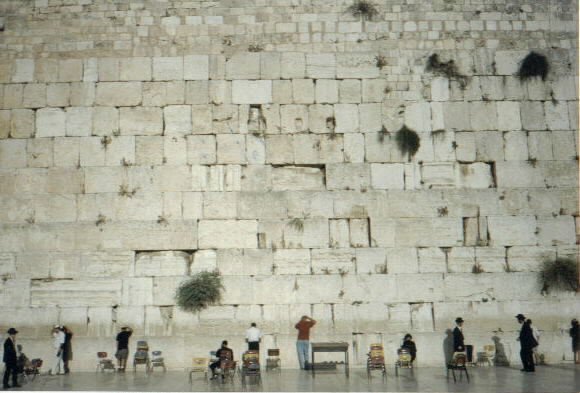
He went on to comment on the Western or Wailing Wall. He said, "The wall is not part of the Jewish temple. It is just the western wall of the mosque. There is not a single stone with any relation at all to the history of the Hebrews."

These sentiments were echoed by a Waqf (Muslim Religious Authority) archaeologist.

These are the current opinions of the Muslims Israel is going to "negotiate" with at Annapolis. They do not recognize the existence of Jewish history in Jerusalem, and President Abbas agrees with them.

The Bush Administration and the Olmert government are legitimizing these people by talking to them.

Stop this madness.


Well of course the Temples didn't exist. Al aqsa has been on al-quds since the time of Ibrahim. Everyone knows that Islam pre-dates all known religions and that allah chose al aqsa and al-quds as holy places to supplement Mecca and the Ka'bah.

The religious myth that Islam cares a hoot for Yerushalayim is built on the wobbly foundation of Islam's cultural and structural under-pinning. Jerusalem is holy to Islam and Christianity too for that matter ONLY because it is holy, now and forever to the Jews. That HaShem chose Jerusalem for the Jewish capital is fodder for all the replacement ideologies that we still see today. Yoshka walked the streets of Jerusalem because it was the Jewish center of life. It was holy before him, not made holy because of him. The conquering arabic hordes didn't make Jerusalem holy nor was this a goal. To the contrary they arrived there because the Christians were there and blocking their way of Islamic suppression of infidels. The whole Islamic claim is based upon a dream of Mohamed recorded in the Koran, not mentioning Jerusalem by name. In fact, Al-Aqsa was built after the death of Mohamed. At the time of Mohamed's "dream", Jerusalem was under full Christian Byzantine control.

Only the Jewish people can truthfully claim Jerusalem from a religious and national perspective. "World peace" whatever that actually means, will only be achieved when Muslims learn the truth and seek forgiveness from the Jews. But don't hold your breath. It takes humility to admit an error. Humility to the arab in particular means not stepping back but being stepped upon: humility = humiliation. Judging by the claims in the article above, the time for peace has not yet arrived.

On the other hand, the madness that is Islam's claims plagues us today and could be a punishment for not having cleared Har HaBayis in 1967. The yissurim of Israel are self-imposed. HaKodesh Baruch Hu strengthen the faith of your children to do your will.

Stumble Upon Toolbar

16 November 2007

Jewish Posterity for $8,000

This Dvar Torah was originally written in 2005 and can be found here. I received it by email this week. It struck me after having written my commentary A Flashy Bookmark Found Amongst The Torn Pages of a Discarded Shulchan Aruch. Rabbi Posner's general theme of Jewish continuity and the message conveyed by Ms. Berman in the article that I commented upon are interesting to compare. I took special note of the last paragraph:


"For these are the children of Jacob" conveys a faith that the chain is worth more than what a link lacks. We have nachas that our children are part of this chain, and we say a little prayer that they earn (for how else will they pay day-school tuition?) a whole lot more than $8,000 a year.


Finally, the Dvar Torah includes sagely advice from Mrs. Posner OBM.


FOR YOUR SHABBAT TABLE
By Rabbi Shimon H Posner
***************
My son the doctor had a son:
he is now a neurosurgeon.
His son is a forest-ranger in Yosemite:
the girl he is not yet married to is not Jewish.
My son the lawyer had a daughter:
she is a senior analyst with Morgan Stanley:
she's forty-three and just met Mr. Right.

A survey of Jewish America was unveiled two years ago:
containing little we didn't already know anecdotally.
Still, some of the numbers were shocking.
Three hundred thousand less Jews
than there were only ten years ago?
Forget Zero Population Growth:
we're eating away at our capital. And for what?
Because, as the survey reported, we earn $8,000 per year more than the average American family!
We're not having kids
so we can go out and earn an extra minimum wage.
My kingdom for a horse;
My birthright for $8,000 worth of lentils.

The problem is not that Jewish women don't want to be Jewish mothers:
it's that Jewish men don't want to be Jewish fathers.
Manis Freidman sees feminism as a cry,
piercing through the upshot of the Industrial Revolution:
"Give us back the husbands that you stole from us!"
Until that revolt, men grew into fathers:
fathers needed to provide, so men worked.
Gradually men stopped working to provide,
they went off to pursue a career,
self- fulfillment, a more meaningful life(style).
Who would want to be the mother of their children?

Perhaps more than any parsha, ours is laden with domesticity: it is painful to hear, from our perspective,
women pining for children and for their husband's attention
that childbearing would earn them.
More easily overlooked is the husband
who watched sheep all day in order to raise a family.
Bucolic as it may sound, this was not a sign of the times;
his twin brother led a high-pressured, adventurous, corporate-mogul lifestyle.

'Will our children say kaddish for us?'
was the worry of a generation gone by.
'We have no children.'
is the silent scream of the most comfort-conscious generation. Worry and concern of a Jewish future is misused,
overplayed and gauche.
Charged-up activism is annoying. Neither work.
Go get a job! Become successful! is the cry.
And the kids listen, in droves.

One of the positive aspects of the Sixties-Seventies is idealism: a greasy-haired, pot-induced, thoroughly-off-base idealism, but idealism. When the surviving hippies (the ones who didn't OD in Marrakech) took a bath and trimmed their hair they were also cleansed of selflessness and had their strife of the spirit cut short. The lucky ones had someone to help them channel their idealism.

Parents want to provide children with whatever the parents grew up missing.
A greater accomplishment is to provide children with whatever the parent grew up taking for granted.

It is not enough to want grandchildren.
You must want sons who are fathers more than you want sons who are doctors, want daughters who are mothers more than daughters who are market analysts.
You must want sons-in-law who are fathers
more than sons-in-law who are neurosurgeons.

My mother taught me
that you can never choose to have a child:
you can only choose not to have a child.

"For these are the children of Jacob" conveys a faith that the chain is worth more than what a link lacks. We have nachas that our children are part of this chain, and we say a little prayer that they earn (for how else will they pay day-school tuition?) a whole lot more than $8,000 a year.

Stumble Upon Toolbar

12 November 2007

To Sanctify the Profane

National Jewish conference focuses on youth
More than 3,000 leaders expected at Nashville event


By COLBY SLEDGE
Staff Writer

Published: Monday, 11/12/07
The gathering sounded like a college football game, complete with pep-rally music and pennant-waving students.

Instead, the scene was the United Jewish Communities' annual General Assembly, which is expected to bring more than 3,000 Jewish leaders to Nashville this week. The event runs through Tuesday at the Gaylord Opryland Hotel and Convention Center.

With about 8,000 Jews in Nashville and around 20,000 statewide, Tennessee's Jewish community is the smallest to ever host the conference.

"It's really been quite an undertaking," said Judy Saks, community director for the Jewish Federation of Nashville. Saks' organization is teaming with similar chapters in Chattanooga, Knoxville and Memphis to provide volunteers for the event.

Although discussion topics will vary, the overwhelming issue for Jewish leaders is the same facing other religions: figuring out how to keep younger generations involved.

"That's the big question, and if you have the answer, we'll pay you a lot for seminars," Saks said. "It's probably going to involve a complete change in the way we are doing things."

Students get involved

More than 200 students from colleges ranging from the University of Michigan to Vanderbilt University are expected to attend the conference, which includes sessions on involving young adults in Jewish life.

"I'm here to learn a lot more about my Jewish identity," said Jon Hurst-Sneh, a University of Kansas student. "We're here to realize our religion."

Hurst-Sneh was among about 60 Jewish students and young adults who volunteered at the Nashville Rescue Mission on Sunday morning, sorting clothing, preparing food and speaking with men and women at the complex.

Volunteer and service work are likely to play a prominent role in future Jewish teaching of students, said Saks.

"They really want to put the things that they have learned in religious school to work, and one of those things is helping others and involving younger people," Saks said.

The students and other attendees will have several prominent leaders, Jewish and otherwise, to look to during the conference. Sunday's speakers included Gov. Phil Bredesen, and Secretary of State Condoleezza Rice will address the assembly Tuesday morning.

"Judaism doesn't stand between being secular and being orthodox," said Pnina Gaday, an Ethiopian Jew who fled to Israel and now leads a student group in Tel Aviv. "Orthodoxy is scaring a lot of students. There are a lot of ways to be Jewish on both sides."


Why do college age youth go the GA to learn about yiddishkeit? Why not spend a semester in Yeshiva? Today, there are plenty of "kiruv" or better "in-reach" (read it as enrich) yeshivas for boys and girls which will inspire growth in Judaism not only by advancing their knowledge of Torah but by spiritually motivating the 'soul' of the wandering and lost Jew. Indeed, all Jews are of one soul. (for reference material on the single neshama of Israel and the ideas implications, see Chassidic Dimensions, Shochet).

One would do well to begin this path with a desire to cling to HaKodesh Baruch Hu while overcoming the urge to look for an excuse not to do so. This is a direct challenge to the "I need to be inspired" crowd. It isn't inspiration so much which is lacking but commitment.

I would bet that most people making the "inspiration" argument have either played organized sports, taken up an instrument, dance, art or any hobby which must be nurtured. In the effort to learn or master the necessary skills, did they need inspiration or commitment? Clearly, the matter is one of desire to achieve. No one gives this to a Jew, it must come from inside. The inheritance is a gift but it must be brought out from the shell it is hidden in. But what of the end product? A sports player plays the game in the end, and the piano keys are stroked producing a melody. What of the Jew? Here we come to the loggerhead. What is the purpose of this search for meaning or spirituality? Is it to have some sense of satisfaction or accomplishment? Or is it something else, larger than the very person.

A Jew looks for HaShem for no other reason than to discover himself. How so? Since HaShem, Israel, and Torah are united in eternal oneness, the search for spirituality is to find oneself, or better to recognize the divine source of the soul itself. We are mere vessels carrying the soul. HaShem blew that soul into us. It seeks to return to it's source at all times, but the body selfishly refuses to let it go. And this, may I venture, is a secret of Jewish life. The body refuses to let the soul have it's way seeking to meet it's own agenda. However, being stuck together for a tour on earth, the soul and body must work together throughout life. The yetzer hara empowers the body in its effort to control the soul. The soul cries out to it's creator for strength to overpower the urges of the yetzer hara. The body can be convinced to do right and the soul can be taught to give in to foreign influences. It is an effort in the intellectual realm which drives a Jew toward an observant path away from a not yet observant path. A conscious effort is needed to turn aveiros into mitzvos.

Sorting clothes at a shelter might be a good thing to do. If it is done because it makes the body feel good, then it has affected the soul negatively. If it is done because the soul says, it's an act of chesed for you to should sort clothes at the shelter, and the body says, "I would rather be sleeping but will go if you make me", then the soul has influenced the body in a positive way. This is called sanctifying the profane and is a message as I see it that the Rebbe taught. Make what you do holy. This message is what is missed by college students at the GA. Spirituality doesn't follow attempts to "realize our religion". Rather it is the love of humanity and desire to do what HaShem wants which teaches how we "realize our religion".

"Judaism doesn't stand between being secular and being orthodox," said Pnina Gaday, an Ethiopian Jew who fled to Israel and now leads a student group in Tel Aviv. "Orthodoxy is scaring a lot of students. There are a lot of ways to be Jewish on both sides."


Pnina, it isn't Orthodoxy" which scares students, it is the commitment which scares students. It is the fear of being Jews, who Think Jewish, act Jewish and appear Jewish which scares students. Your position is a false dicotomy. Orthodox or secular is not the choice. Jewish or not is the choice. You seem to wish to define Judaism based upon what is good for you. It isn't Orthodoxy which scares you it is the fear that you cannot set and keep the standards for which you are comfortable.

Comfort is not what makes you feel good but a sense of continuity, that you are able to keep the tradition of your ancestors alive and meaningful. This is a true comfort and what HaShem expects from you. Connectivity to the past and future is your reward. But it is hardly your only obligation. While it is truly hard work to live up to HaShem's expectations, seeing through the facade of self-determination Judaism is harder.

Stumble Upon Toolbar

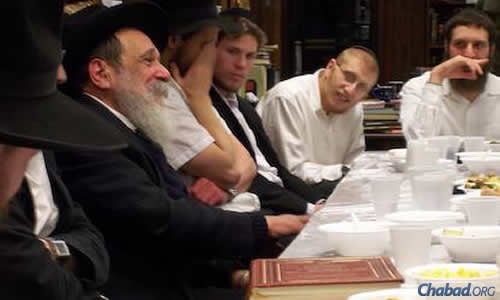
Kinus HaShluchim 5768 Group Photo


It is always an impressive show of black that Chabad throws every November during the Shluchim meeting. The number of those in attendance grows every year.


Shturem's cameraman found Rabbi Posner during the seating and preparation for the group photo.
Stumble Upon Toolbar

What Words Offend Arabs? The Truth.

Children's Poetry Booklet Recalled After Arabs Complain
(Israeli censorship kowtows to Arabs.
When Will We Tell The Truth Without Fear)

(IsraelNN.com 7 Sivan 5768/June 10, '08) Ynet's web site and Arab complaints against a ten-year-old boy's poem about terrorists has resulted in the recall of all of the Nes Ziona municipality's children's poetry booklets.

Ynet boasts that its coverage of the poem resulted in its being recalled.

The text of the poem (Ynet's translation):

Ahmed's bunker has surprises galore: Grenades, rifles are hung on the wall. Ahmed is planning another bombing!What a bunker Ahmed has, who causes daily harm.Ahmed knows how to make a bomb. Ahmed is Ahmed, that's who he is, so don't forget to be careful of him.We get blasted while they have a blast!Ahmed and his friends could be wealthy and sunny, if only they wouldn't buy rockets with all their money.

Poetry competition director Marika Berkowitz, who published the booklet, was surprised at the protests and told Ynet: "This is the boy's creation and this is what he wanted to express. Of course there should be a limit, but I think the there is no racism here. 'Ahmed' is a general term for the enemy. These are the murmurings of an innocent child."

The Education Ministry told Ynet: "The local authority that published the booklet should have guided the students in a more correct manner through the schools. The district will investigate the issue with the local authorities."
4Torah.com
4Torah.com Search from Pre-Approved Torah sites only
Photobucket
Custom Search

Twitter Updates

    follow me on Twitter